The Definitive Guide for 2026: How to Best Hire Employees
The Rise of the Skills-Based Organization
Traditional job descriptions, built on rigid credentials and years of experience, are becoming obsolete. Forward-thinking companies are now mapping roles to specific, demonstrable skill clusters. This shift, powered by AI-driven talent platforms, allows you to source candidates based on verified competencies—like data storytelling, agile project management, or prompt engineering—rather than just pedigree. This opens a wider, more diverse talent pool and directly aligns hiring with actual business needs.
Hyper-Personalization of the Candidate Journey
In 2026, a one-size-fits-all application process is a competitive disadvantage. Candidates expect a journey tailored to their profile. This means dynamically adjusting application steps, providing role-specific preparatory content, and utilizing AI chatbots that can answer nuanced questions about team culture and projects in real time. Personalization reduces drop-off rates and signals that your company values individuals, not just resumes.
Predictive Analytics for Fit & Retention
Hiring is moving from reactive to predictive. Advanced analytics now model a candidate's potential for success, team fit, and long-term retention by analyzing patterns in anonymized workforce data. These tools can flag potential mismatches in work-style preferences or predict which candidates are most likely to thrive in your unique environment, drastically reducing costly mis-hires and improving team cohesion from day one.
Implementing the 2026 Hiring Framework: A Step-by-Step Guide
Phase 1: Redefining the Role with Skills Mapping
Before posting a single job ad, start by deconstructing the role. Collaborate with the hiring manager and team to list every essential task. Then, translate these tasks into a hierarchy of skills: Core Technical Skills (e.g., Python for data analysis), Human Skills (e.g., cross-functional collaboration), and Emerging Skills (e.g., adaptability to new AI tools).
Example: Instead of requiring"5 years of marketing experience," your skills map for a Content Strategist might specify:"Ability to develop a content calendar using Asana (Tool Proficiency),""Proven skill in increasing organic traffic by 20% year-over-year (Outcome Focus)," and"Experience collaborating with data analysts to inform topic strategy (Collaborative Skill)."
This map becomes the single source of truth for every subsequent hiring stage, from sourcing to interview questions to evaluation.
Phase 2: Sourcing in the New Talent Landscape
The war for talent is no longer fought solely on LinkedIn. By 2026, proactive sourcing involves:
- Internal Talent Marketplaces: Encourage internal mobility by allowing employees to post"micro-projects" or express interest in new skill paths, often uncovering hidden internal candidates.
- Skills-Based Platforms: Utilize platforms like Gloat, Guild, or even advanced GitHub searching to find individuals with verified skill badges or project portfolios.
- Community-Driven Sourcing: Engage with niche online communities (e.g., a specific Stack Overflow forum, a Discord channel for UX researchers) where passive top talent congregates and contributes.
Sourcing becomes a continuous, relationship-building activity, not a transactional one triggered by an open req.
Phase 3: The Evolved Interview Process
The marathon of sequential interviews is inefficient and candidate-hostile. The 2026 model is streamlined and evidence-based:
Structured Skill Assessments
Replace hypothetical questions with realistic, timed work samples. For a developer, this might be a paired debugging session on a real (sanitized) codebase issue. For a sales role, a simulated pitch to a difficult client via video.
Bias-Interrupted Panels
Use software that anonymizes candidate responses during initial reviews or prompts interviewers with standardized, legally-vetted questions based solely on the skills map, reducing unconscious bias.
The goal is to gather objective data on the candidate's abilities, creating a comparable scorecard for all finalists.
Phase 4: Data-Driven Decision Making & Onboarding
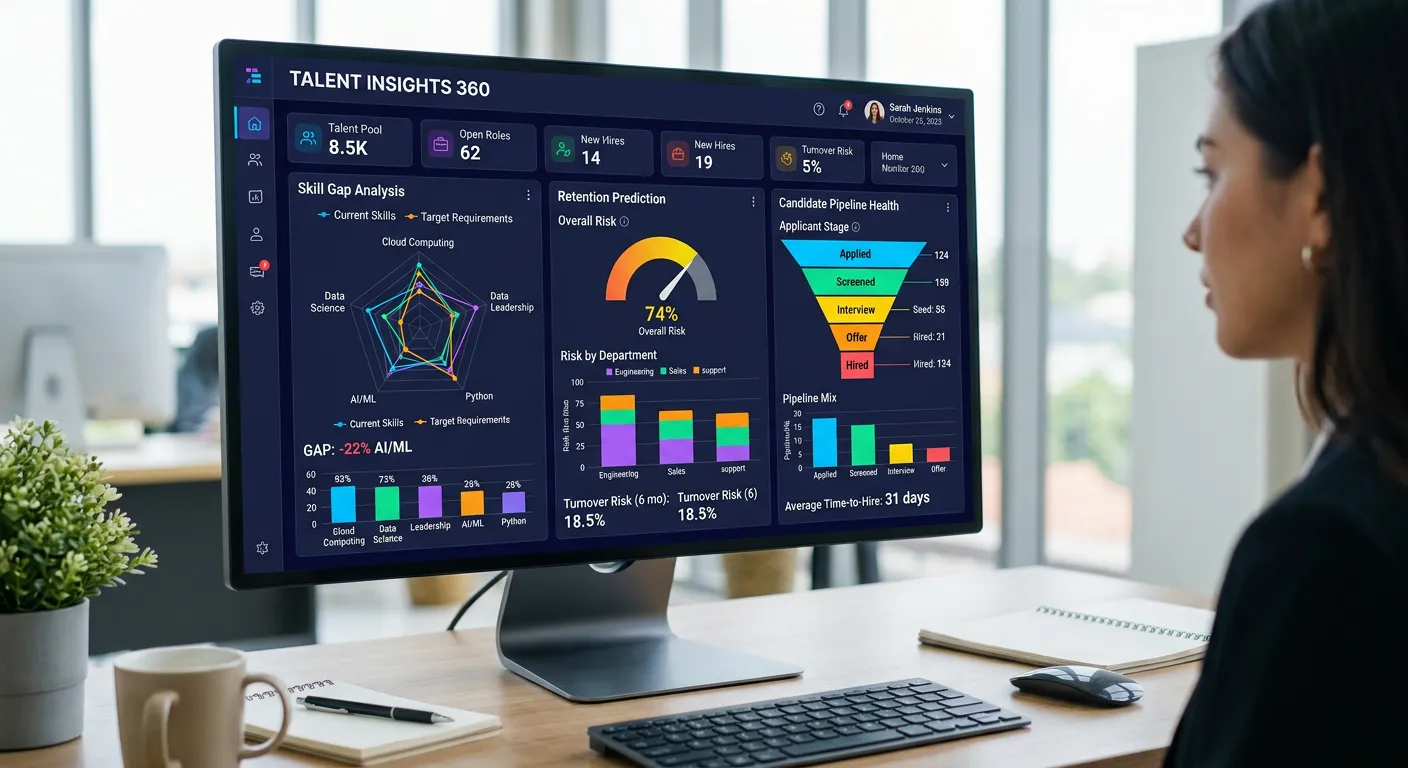
The final hiring decision is supported by a consolidated dashboard, not just gut feeling. This dashboard aggregates scores from skill assessments, interview panel feedback, and predictive analytics on cultural fit.
Once hired, the personalized journey continues. Onboarding in 2026 is powered by the initial skills map, creating a tailored 90-day plan that addresses skill gaps and connects the new hire with mentors and resources specific to their needs, accelerating time-to-productivity.
Case Study: Transforming Hiring at"TechFlow Inc."
The Challenge
A mid-sized SaaS company, TechFlow, faced a 45-day average time-to-hire and a 25% first-year attrition rate. Their process was conventional: generic job posts, resume screening, and unstructured interviews leading to hiring manager fatigue and inconsistent outcomes.
The 2026 Strategy Implementation
TechFlow committed to a full overhaul over two quarters:
- Skills-First Role Design: They rebuilt 20 core role profiles using skills mapping workshops, identifying key competencies for a"Senior Product Designer" like"User Journey Prototyping in Figma" and"Quantitative Usability Data Synthesis."
- AI-Enhanced Sourcing: They deployed an AI tool that scanned portfolios on Behance and Dribbble, scoring them against the skills map and flagging high-potential candidates who lacked traditional"enterprise experience."
- Virtual Assessment"Days": Candidates participated in a half-day virtual program with a collaborative design challenge (observed by the team), a culture-fit conversation with peer designers, and a stakeholder feedback simulation.
- Predictive Scoring: All feedback and assessment results were fed into a platform that generated a fit score and predicted 18-month retention likelihood.
The Results
"We stopped hiring for a 'culture fit' that unconsciously mirrored our existing team. By focusing on skills and structured data, we built a more innovative and resilient design team. The best part? We discovered incredible talent we would have previously screened out." – CHRO, TechFlow Inc.
Navigating Ethical Considerations and Pitfalls
Advanced hiring tools bring immense power, which must be balanced with responsibility and human oversight.
⚠️ Algorithmic Bias
The Risk: AI models trained on historical hiring data can perpetuate existing biases if not carefully audited.
The Mitigation: Regularly audit your AI tools for disparate impact. Use diverse training data sets and involve ethicists in the procurement process. Always maintain human-in-the-loop for final decisions.
⚠️ Candidate Experience & Transparency
The Risk: Over-automation can make candidates feel processed by a machine, damaging your employer brand.
The Mitigation: Be transparent about the use of AI. Explain how it's used (e.g.,"An AI will scan your portfolio for specific skills to help our team"). Ensure clear, human communication channels remain open throughout.
⚠️ Data Privacy & Security
The Risk: Collecting vast amounts of candidate data (video interviews, assessment results) creates a significant security liability.
The Mitigation: Adhere strictly to GDPR, CCPA, and other regional regulations. Implement robust encryption, clear data retention policies, and give candidates control over their data. Choose vendor partners with impeccable security credentials.
Preparing Your Team for 2026
The future of hiring requires a shift in mindset and capability across your organization.
For HR & Talent Leaders
- ✅ Develop fluency in people analytics. Learn to interpret predictive models and skill data.
- ✅ Become a strategic consultant to business leaders, guiding them on skills-based role design.
- ✅ Vet and manage relationships with AI-driven HR tech vendors ethically and effectively.
For Hiring Managers & Teams
- ✅ Move from judging"experience" to evaluating demonstrated"skills" and"potential."
- ✅ Engage in structured interview training to minimize bias and maximize objective data collection.
- ✅ Participate actively in defining the skills map for your team's roles.
Conclusion: Building a Future-Proof Hiring Engine
The definitive guide for 2026 points toward one clear conclusion: hiring is no longer a administrative function but a core strategic capability. The companies that thrive will be those that embrace skills as currency, data as insight, and personalization as standard.
This evolution is not about replacing human judgment with machines, but about augmenting human intelligence with better tools and processes. It frees up recruiters and hiring managers to do what they do best—build genuine relationships, assess nuanced qualities, and advocate for candidates—while removing the noise, bias, and inefficiency that have plagued hiring for decades.
Your 2026 Action Plan
- Audit Your Current Process: Identify one pain point (e.g., low diversity in shortlists, long time-to-fill) to pilot a new approach.
- Pilot Skills Mapping: Select one critical role and work with that team to create a skills-based profile for the next opening.
- Evaluate One New Tool: Research and demo a platform that addresses a specific weakness, be it skills assessment, predictive analytics, or bias interruption.
- Train Your Teams: Invest in upskilling your talent acquisition and management teams on the principles of future-ready hiring.
The future of hiring is more equitable, efficient, and effective. It starts not in 2026, but with the decisions you make today.
The Technology Stack Powering 2026 Hiring
The strategic shifts outlined are enabled by a new generation of integrated HR technologies. Understanding this stack is crucial for effective implementation and vendor selection.
AI-Powered Talent Intelligence Platforms
These platforms form the central nervous system. They go beyond Applicant Tracking Systems (ATS) by aggregating data from internal systems (performance reviews, project completions) and external sources (skills platforms, portfolio sites). Using machine learning, they create dynamic talent pools.
In Practice: A platform like Eightfold AI or Phenom can proactively alert a hiring manager:"Based on the skills map for your open DevOps role, we have identified 3 strong internal candidates in the Infrastructure team who are 85% skill-matched and have expressed career mobility interests. We've also sourced 12 external candidates with verified Kubernetes expertise from the OpenSkills network."
These systems provide predictive"flight risk" scores for existing employees and"success likelihood" scores for candidates, creating a holistic view of talent supply and demand.
Immersive & Gamified Assessment Tools
Static personality tests are being replaced by immersive simulations that mirror real job challenges. These tools assess cognitive ability, problem-solving, and soft skills in a contextual environment, providing richer, more equitable data than self-reported surveys.
Virtual Reality (VR) Assessments
Used for high-stakes or physical roles. A maintenance engineer candidate might troubleshoot a faulty virtual pump system. A retail manager could navigate a simulated Black Friday crowd scenario, managing customer complaints and inventory checks in real-time.
Serious Gaming Platforms
Platforms like Pymetrics use neuroscience-based games to measure traits like attention, risk tolerance, and empathy. Candidates play a series of short games, and their results are compared against benchmarks of high performers in the target role, focusing on potential rather than pedigree.
The key advantage is objective comparability: every candidate faces the identical, controlled scenario, removing interviewer variability.
Blockchain for Verifiable Credentials & Portfolios
By 2026, the issue of credential fraud and the hassle of verifying degrees and certificates will be largely solved. Blockchain-based digital wallets allow individuals to own and share verifiable, tamper-proof records of their achievements.
- Micro-Credentials: A candidate can share a blockchain-verified badge for completing a specific Google Cloud course, issued directly by the platform.
- Project Portfolio Verification: Code commits on GitHub, design files on Figma, or strategy documents can be cryptographically signed and linked to a digital profile, proving direct contribution.
- Work History Validation: Previous employers can issue standardized digital"proof of employment" records, detailing role, tenure, and even high-level performance metrics with the employee's consent.
This shifts the burden of proof from the hiring company (conducting background checks) to the candidate presenting pre-verified assets, speeding up the process immensely.
Deep Dive: Building a Skills Ontology for Your Organization
A skills map for a single role is powerful; a unified skills ontology for the entire organization is transformative. This is a common, structured vocabulary that defines and relates all skills relevant to your business.
Why an Ontology is a Game-Changer
Without an ontology,"Python programming" in the Engineering department and"Python for data analysis" in Marketing are seen as separate, unrelated skills. An ontology defines"Python" as a parent skill, with child skills for specific applications (e.g.,"Data Science Libraries,""Automation Scripting"). This enables:
Internal Mobility
Easily identify employees in declining business units who possess adjacent skills for growth areas.
Strategic Workforce Planning
Model the future skill supply vs. demand and build targeted upskilling programs at scale.
Precision Sourcing
Search for candidates based on skill combinations and adjacencies you wouldn't have considered.
Step-by-Step: Creating Your Ontology
- Foundational Audit: Use text mining on job descriptions, performance reviews, and project documentation to extract a raw list of skill keywords. Involve subject matter experts from each department to categorize them.
-
Define Relationships: Determine hierarchies (parent/child skills), equivalencies (e.g.,"Agile Methodology" includes"Scrum" and"Kanban"), and dependencies (e.g.,"Advanced Statistical Modeling" requires"Intermediate Python").
Example Relationship: Parent Skill: Communication. Child Skills: Written Reporting, Stakeholder Presentation, Active Listening. Related Skill: Influence.
- Integrate with External Frameworks: Align your internal ontology with public frameworks like ESCO (European Skills/Competences, qualifications and Occupations) or O*NET. This ensures your skill language is portable and understood by external platforms and candidates.
- Implement & Maintain: Embed the ontology into your HR systems. Assign"skill stewards" in each business unit to review and update it quarterly, adding emerging skills (e.g.,"Quantum Computing Basics") and retiring obsolete ones.
Case Study: GlobalScale Logistics – Upskilling and Hiring at Scale
This case demonstrates how a future-proof hiring strategy is inextricably linked to internal talent development.
The Context
Facing automation in its warehouse operations, GlobalScale needed to transition 5,000 warehouse associates into new roles in logistics analytics, robotics maintenance, and customer experience over three years. Simultaneously, they needed to hire 2,000 new data scientists and engineers externally. Their old, separate processes for hiring and L&D were insufficient.
The Integrated 2026 Solution
They launched the"Future Skills Passport" program, powered by a unified talent platform.
For Internal Talent
- 🔄 Each associate completed a skills assessment against the new target roles, creating a personalized"skill gap" report.
- 🔄 The platform recommended micro-learning modules (from Coursera, internal experts) and"stretch assignments" to build missing skills.
- 🔄 As skills were validated (via project completion or assessments), digital badges were issued to their internal passport.
For External Hiring
- 🎯 External job posts explicitly listed the same skills and accepted equivalent digital badges from public platforms (e.g., a TensorFlow certification).
- 🎯 The hiring platform prioritized candidates (internal and external) whose verified skills best matched the ontology, regardless of background.
- 🎯 A portion of external roles were reserved for"apprenticeship" tracks, where high-potential but skill-gapped candidates were hired with a guaranteed upskilling plan.
Quantifiable Outcomes
| Metric | Before Program | After 24 Months | Impact |
|---|---|---|---|
| Internal Mobility Rate | 4% | 31% | +675% |
| External Hire Time-to-Productivity | 6 months | 3.2 months | -47% |
| Cost per Hire (External Tech Roles) | $28,500 | $18,000 | -37% |
| Voluntary Attrition (Tech Hires) | 22% (Year 1) | 8% (Year 1) | -64% |
"The 'Future Skills Passport' broke down the artificial wall between recruiting and learning. We stopped seeing talent as 'internal' or 'external' and started seeing a continuum of skills we could cultivate or acquire. Our workforce is more agile, engaged, and future-ready because they own their development paths." – Chief Talent & Innovation Officer, GlobalScale.
The Human Element: Augmented, Not Replaced
The most sophisticated technology fails without the right human oversight and interaction. The 2026 hiring model redefines the roles of recruiters, hiring managers, and candidates themselves.
The Recruiter as Talent Advisor
Freed from manual screening, recruiters become strategic partners. They interpret analytics, coach hiring managers on skills-based interviews, and serve as the primary human touchpoint—managing candidate relationships, negotiating complex offers, and ensuring brand ambassadorship.
The Hiring Manager as Coach & Scout
Their role shifts from ultimate decider to expert assessor and team coach. They design the real-world work samples, observe candidate performance in simulations, and use structured data to make decisions. They also proactively"scout" for talent in professional communities.
The Candidate as Active Curator
Candidates are expected to actively manage their verifiable skill portfolio. They curate evidence of competencies—code repositories, case studies, peer endorsements—in a digital wallet. The application process becomes a two-way exchange of validated data, not a one-way submission of a resume.
Critical Soft Skills for the 2026 Hiring Team
As processes become more data-driven, these human skills become more valuable:
- 1 Data Literacy: The ability to question, interpret, and tell a story with hiring metrics and predictive scores.
- 2 Ethical Reasoning: Navigating the moral complexities of AI, bias, and data privacy in hiring decisions.
- 3 Empathetic Communication: Conveying rejection or complex feedback with clarity and compassion in a partially automated process.
- 4 Change Management: Guiding resistant teams through the cultural shift from intuition-based to data-augmented hiring.
Looking Beyond 2026: The Emerging Frontiers
The evolution will not stop. Savvy leaders are already looking at the horizon to understand the next wave of transformation.
Neuro-inclusive Hiring & Brain-Computer Interfaces (BCI)
The next frontier of DEI is neurodiversity. Future tools may use non-invasive BCI or eye-tracking during assessments to understand how different candidates solve problems, not just the final answer. This could optimize assessment design for neurodivergent thinkers (e.g., those with ADHD or Autism) and identify unique cognitive strengths like pattern recognition or sustained focus that traditional interviews miss.
Ethical Consideration: This requires unprecedented levels of candidate consent, transparency, and data protection, moving into highly sensitive biometric information.
The Metaverse & Persistent Digital Workspaces
The interview process may move into persistent corporate metaverse spaces. A candidate for a global team could spend a day in a digital"office," interacting with AI avatars of future teammates, completing collaborative tasks on virtual whiteboards, and experiencing the company culture in a simulated environment. This provides a richer sense of fit than a 2D video call and allows for asynchronous assessment across time zones.
Generative AI for Role & Team Design
Beyond assessing candidates, AI will help design the work itself. Leaders could input strategic goals, and generative AI models would propose optimal team compositions, balancing skills, personalities, and projected innovation output. It could dynamically suggest splitting a large role into two more focused"micro-roles" or identify hybrid skill combinations needed for projects that don't yet have a name.
Example Prompt:"AI, design a team to launch a new sustainable product line in Q3 2026, considering our existing talent pool, projected market skills scarcity, and an innovation-weighted culture profile."
Begin Your Evolution Today
The journey to 2026 hiring doesn't require a massive budget or immediate full-scale overhaul. It requires intentional, incremental steps toward a new philosophy.
📋 Week 1-4: The Diagnostic Sprint
- Conduct a"hiring process autopsy" on your last 5 hires. Map the time spent, tools used, and decision points.
- Survey recent candidates (hired and not hired) on their experience. Identify one major friction point.
- Audit one key job description. Highlight all credential-based requirements and brainstorm the underlying skills they represent.
🛠️ Quarter 1-2: The Pilot Project
- Select one non-critical, high-volume role (e.g., Customer Support Specialist).
- Build its skills map with the team. Redesign the job post around these skills.
- Use a low-cost, dedicated skills assessment tool (e.g., Vervoe, TestGorilla) for screening.
- Measure everything: candidate satisfaction, time-to-hire, quality of hire (at 90 days). Compare to your baseline.
The future of hiring is not a distant destination. It is a path defined by a commitment to skills, empowered by data, and guided by human insight. Your next hire is the perfect place to start.
The Financial Imperative: Calculating the ROI of Future-Proof Hiring
Transitioning to a 2026 hiring model requires investment in technology and training. To secure buy-in from finance and executive leadership, you must articulate a clear, data-backed return on investment. The cost of not evolving is far greater.
Quantifying the Cost of the Status Quo
Traditional hiring carries massive hidden costs that erode profitability and competitive advantage. A skills-based, data-augmented approach directly attacks these cost centers.
The Mis-Hire Multiplier
The U.S. Department of Labor estimates a bad hire can cost up to 30% of the employee's first-year earnings. This includes recruitment fees, onboarding time, training, severance, and the lost productivity of the team managing the underperformance.
2026 ROI Lever: Predictive analytics and structured skill assessments aim to drastically reduce mis-hire rates. If a company making 100 hires per year at an average salary of $80,000 reduces mis-hires by just 10 percentage points (e.g., from 20% to 10%), the annual savings would be: (10 fewer mis-hires) x ($80,000 x 0.3) = $240,000.
The Long Time-to-Fill Tax
Every day a critical role is vacant represents lost revenue, stalled projects, and overworked teams. For a revenue-generating role like a sales representative, this cost is direct. For a product developer, it's delayed time-to-market.
2026 ROI Lever: AI-powered talent intelligence and proactive sourcing create dynamic talent pools, slashing time-to-fill. If a tech company reduces its average time-to-hire for engineers from 60 to 35 days, it can bring products to market weeks faster, capturing revenue and market share that would have been lost.
Beyond these direct costs, consider the innovation debt incurred by homogeneous teams and the employer brand erosion from a poor candidate experience, which increases future cost-per-hire.
Building Your Business Case: A Template
To advocate for investment, frame your proposal around these four pillars:
- Productivity Gains: Focus on time-to-productivity rather than just time-to-fill. A new hire using a personalized onboarding plan built from their skills gap analysis will contribute faster. Calculate: (Reduced ramp-up time in weeks) x (Fully loaded weekly salary) x (Number of hires) = Productivity Savings.
- Quality of Hire Uplift: This is measured by post-hire performance reviews, retention at 12 months, and hiring manager satisfaction scores. Propose tracking these metrics before and after a pilot. A 15% increase in hiring manager satisfaction correlates directly with better team outcomes and reduced managerial overhead.
- Strategic Agility: Argue that a unified skills ontology is an asset that enables rapid reskilling for market shifts. This isn't just a hiring tool; it's a risk mitigation and strategic execution tool. The ability to pivot workforce skills quickly is priceless in volatile markets.
- Diversity Dividend: Diverse teams are proven to drive innovation and financial outperformance. Present data showing how skills-based hiring and bias-interrupted processes increase diversity in candidate shortlists. This isn't just an ethical win; it's a commercial imperative with measurable bottom-line impact.
Overcoming Internal Resistance: A Change Management Playbook
The greatest barrier to implementing the 2026 hiring model is often human, not technological. Hiring managers, recruiters, and executives accustomed to legacy processes may be skeptical or resistant.
Identifying the Key Personas & Objections
| Persona | Common Objection | Evidence-Based Counter |
|---|---|---|
| The Intuitive Veteran | "I've hired great teams for 20 years based on my gut. I don't need an algorithm to tell me who's good." | Acknowledge their expertise. Present data showing that unstructured interviews have a low predictive validity (~0.3). Frame new tools as"augmenting your great instincts with data to avoid the occasional costly outlier hire." Share a case study where a"sure thing" gut-feel hire failed. |
| The Overwhelmed Recruiter | "I don't have time to learn a new platform. My ATS is already clunky, and I have 30 reqs to fill." | Focus on reduction of low-value tasks. Demonstrate how AI sourcing can cut screening time by 70%, freeing them for high-value candidate relationship building. Provide dedicated, paid training time as part of the rollout. |
| The Risk-Averse Legal/Compliance Lead | "Using AI and predictive scores opens us up to discrimination lawsuits and regulatory nightmares." | Align with them early. Show how structured, skills-based processes with audit trails are MORE defensible than subjective decisions. Involve them in vendor selection to ensure tools are built with fairness and transparency (e.g., provide bias audit reports). |
The Phased Rollout Strategy
A"big bang" implementation is destined to fail. Instead, use a phased approach that creates wins and builds momentum.
Identify and enroll 2-3 influential, open-minded hiring managers as pilot partners. Give them extra support and a voice in shaping the process.
Run a controlled, fully-supported pilot for 3-4 months on a specific team or role type. Over-communicate progress and gather feedback.
Publicize the pilot's results—both quantitative (faster hiring, better scores) and qualitative (hiring manager quotes, candidate feedback).
Use the success story to roll out to the next wave of teams, using the pilot participants as internal champions and trainers.
Celebrate small victories publicly. When a hiring manager says,"The structured assessment showed me a strength in a candidate I would have missed," capture that testimony and share it widely.
The Global Talent Landscape: Navigating Regional Nuances in 2026
A one-size-fits-all global hiring strategy is obsolete. The 2026 model must be agile enough to adapt to varying regulations, cultural norms, and talent market dynamics across North America, EMEA, APAC, and beyond.
Regulatory Compliance in the Age of AI
The use of AI in hiring is coming under intense regulatory scrutiny worldwide. Your technology stack must be configurable by region.
- EU's AI Act & GDPR: Hiring AI is classified as a"high-risk" system. This mandates rigorous conformity assessments, human oversight, transparency, and data governance. Candidates have a"right to explanation" for AI-driven decisions. Your process must include a clear, simple way to provide this.
- New York City's Local Law 144 (2023): Requires annual bias audits of Automated Employment Decision Tools (AEDTs) and mandates notice to candidates. This model is likely to spread to other U.S. jurisdictions.
- APAC Variability: Singapore promotes AI adoption with flexible guidelines, while China enforces strict data localization laws. In Japan, cultural norms around employment stability may make predictive"flight risk" scores a sensitive topic.
Action: Work with legal counsel to create a global compliance matrix for your hiring tools. Choose vendors who can provide region-specific bias audit reports and data processing agreements.
Cultural Adaptation of the Candidate Journey
Hyper-personalization must account for cultural expectations. What feels efficient in one region may feel cold and impersonal in another.
High-Context vs. Low-Context Cultures
In high-context cultures (e.g., Japan, Middle East), relationship-building is paramount before any formal assessment. The process may need to start with more informal, trust-building video conversations. AI chatbots must be programmed with appropriate formality and respect protocols.
Attitudes Towards Assessment
In some European countries, gamified assessments or invasive VR simulations may be viewed with suspicion. Transparency about how data is used and scored is critical. In competitive tech hubs like Bangalore or Berlin, complex technical assessments are expected and respected.
The solution is a modular process design. The core framework (skills map, data-driven decision) remains, but the touchpoints (initial contact, assessment medium, negotiation style) are locally configurable by your regional talent partners.
Case Study: NexGen Pharma – Hiring for a Skillset That Didn't Exist
This case explores the ultimate test of a future-proof hiring engine: sourcing for a role where no traditional career path exists.
The Challenge
NexGen Pharma, a biotechnology firm, needed to build a new"AI-Assisted Drug Discovery" team. The perfect candidate needed a rare blend of computational biology, machine learning, cheminformatics, and an understanding of clinical trial regulations. Posting a job for a"Computational Biologist with 10+ years of AI experience" yielded almost zero qualified applicants. The talent simply didn't exist in a single, traditional profile.
The 2026 Approach: Adjacent Skills & Potential Mapping
They abandoned the search for a unicorn and used their skills ontology to deconstruct the role into adjacent skill clusters and, crucially, learning agility indicators.
- Skill Deconstruction: They identified that success hinged on three clusters: Data Science Proficiency (Python, ML frameworks), Domain Knowledge (basic molecular biology), and Regulatory Acumen (understanding of FDA submission processes). They prioritized the first as non-negotiable and the latter two as trainable.
- Potential-Forward Sourcing: Their AI talent platform was configured to search for data scientists in adjacent fields (e.g., astrophysics, quantitative finance, geospatial analysis) who had demonstrated rapid skill acquisition in past projects and had any exposure to scientific domains.
- Project-Based Assessment: Candidates were given access to a sanitized dataset and asked to complete a two-week, paid"micro-project" proposing a machine learning approach to a specific drug interaction problem. This assessed their problem-solving and ability to learn a new domain quickly.
- The"Tandem Hire" Model: For their first five hires, they paired one highly skilled data scientist from finance with one mid-level computational biologist. They hired for complementary skill sets and high collaboration scores, betting on team-based learning.
Outcomes & Evolution
Within 9 months, the newly formed team had developed a predictive model that reduced pre-clinical compound screening time by 40%. The"tandem hires" reported high job satisfaction due to continuous cross-skilling. NexGen Pharma updated its skills ontology in real-time, creating new internal skill badges for"Cross-Domain AI Application" and formalizing this"adjacent skills hiring" playbook for other innovative functions.
"We stopped looking for a finished product and started looking for the most powerful learning engine. Our best hire was a former quantitative analyst from hedge fund who was fascinated by protein folding problems. She had zero pharma experience, but her GitHub showed she could master complex domains in weeks. She's now leading the team. The old process would have filtered her out instantly." – Head of AI Innovation, NexGen Pharma.
Sustaining the Model: The Continuous Feedback Loop
A future-proof hiring engine is not a project with an end date. It is a living system that requires continuous input and refinement to remain effective and ethical.
Closing the Loop: From Performance Back to Hiring
The most powerful data doesn't come from candidates; it comes from employees. Integrating post-hire performance data back into the hiring system creates a virtuous cycle of improvement.
1. Validate Predictions
Correlate the"success likelihood" scores given to candidates during hiring with their actual performance reviews at 6, 12, and 18 months. This data is used to retrain and improve the predictive algorithms.
2. Refine the Skills Map
If high performers consistently demonstrate a skill not on the original map (e.g.,"ability to simplify complex tech for sales teams"), that skill is added to the ontology and future assessments.
3. Identify New Sources
Analyze the backgrounds of top performers. Did they come from a specific bootcamp, community, or previous industry? Double down on sourcing from those talent pools.
This requires breaking down data silos between your ATS, performance management system (PMS), and learning management system (LMS). The integrated talent intelligence platform becomes this central hub.
The Quarterly Talent Review Ritual
Institutionalize improvement by making it part of your operational rhythm. Every quarter, convene a cross-functional team (HR, data analytics, hiring managers, legal) to review:
- Bias Audit Reports: Review dashboards showing hiring funnel metrics broken down by gender, ethnicity, and other demographics for any signs of adverse impact.
- Candidate Experience Scores: Analyze feedback from post-application surveys. Is drop-off spiking at a new assessment stage? Is the chatbot providing unhelpful answers?
- Vendor Performance: Are the AI tools delivering on their promised accuracy and efficiency? Should you pilot a new assessment vendor?
- Emerging Skill Scan: Dedicate 15 minutes to brainstorming:"What new skills have we needed in the last quarter that didn't exist a year ago?" (e.g.,"AI Ethics Review,""Sustainable Supply Chain Modeling").
This ritual ensures the hiring engine is constantly tuned, ethical, and aligned with the fast-moving needs of the business.