
Navigating Credit Check For Employment: A Comprehensive Guide for Employers & Candidates
Understanding how financial background checks impact hiring decisions and your rights in the modern UK job market.
Find Qualified Staff TodayLegal Compliance
Conducting a Credit Check For Employment must adhere strictly to UK data protection laws, including the GDPR and the Employment Practices Code. Employers must have a legitimate, justifiable reason for the check and obtain explicit written consent from the candidate.
Pro-Tip: Always document the specific role-related justification for a credit check in your hiring policy. Positions involving significant financial responsibility, access to sensitive data, or company assets are typical examples.
Candidate Transparency
Candidates have the right to know why a credit check is being requested and how the information will be used. A clear, upfront explanation in the job description or interview process builds trust and ensures compliance. For roles like an Interim Finance Director, this transparency is expected.
Risk Mitigation
For employers, a financial background check is a powerful risk management tool. It can help identify potential vulnerabilities related to fraud, theft, or financial pressure that might impact job performance, especially in critical roles found through our business-critical professionals service.
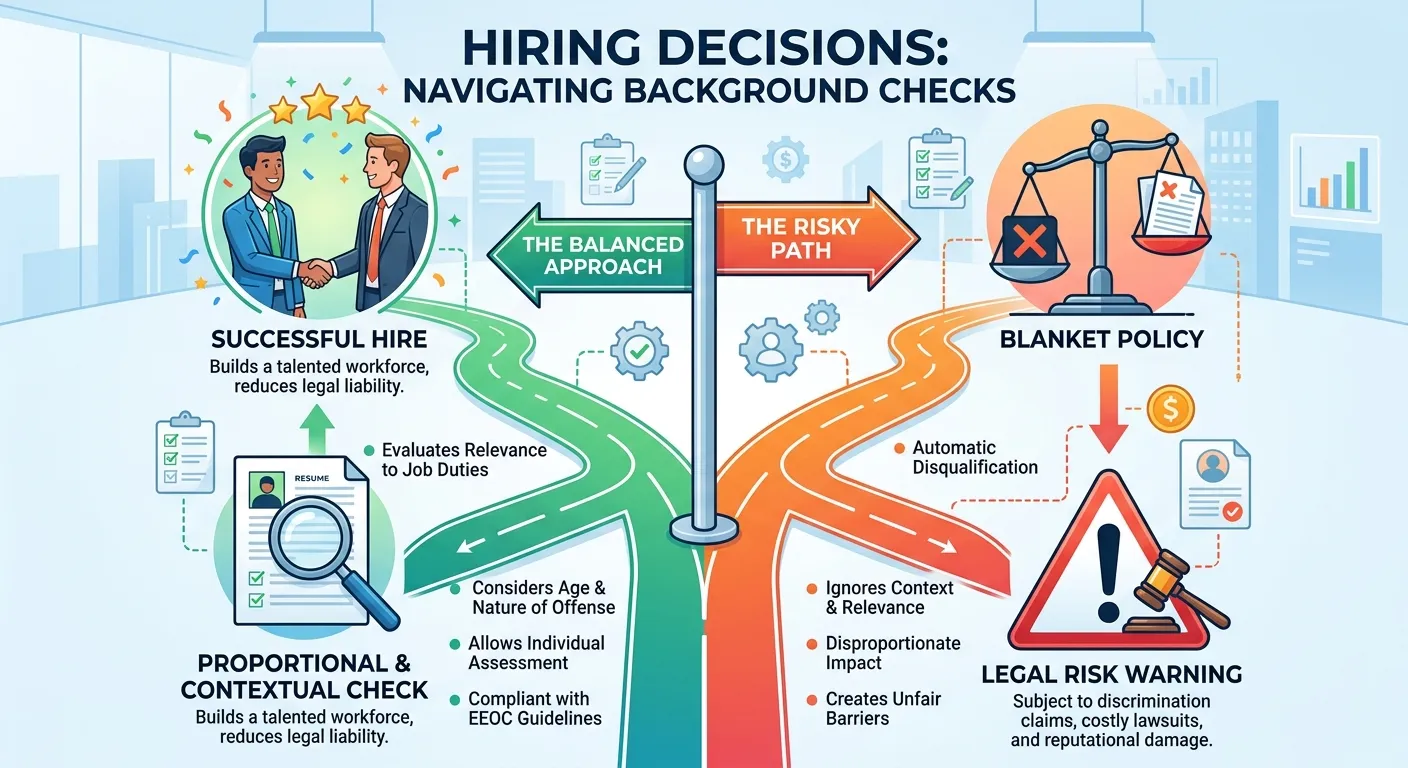
Pro-Tip: A poor credit history should not be an automatic disqualifier. Employers should consider the recency, severity, and circumstances, and offer the candidate a chance to explain.
Credit Checks in Hiring: A Multi-Faceted View
Strategic Use of Credit Checks in Recruitment
For employers, integrating a Credit Check For Employment into the vetting process is a strategic decision, not a blanket policy. It's most relevant for positions of significant fiduciary duty. For instance, while screening for an Urgent Data Entry Clerk may not necessitate one, vetting for senior finance or roles handling large cash transactions might. The key is proportionality and relevance.
- Define Clear Policy: Establish written guidelines specifying which roles require a check and the criteria for assessment.
- Partner with Experts: Work with accredited background screening agencies to ensure legal compliance and accurate reporting.
- Context is King: Use the check as one data point among many—references, experience, interviews—to form a holistic view.
Your Rights and Preparedness as a Candidate
If you're asked to consent to a Credit Check For Employment, don't panic. Understand your rights. You must give explicit permission, and the employer can only check your public financial data (CCJs, bankruptcies) and a modified credit report that excludes your actual credit score and account details. This is true whether you're applying for a Warehouse Operative role that handles inventory or a high-level executive position.
Actionable Steps: Before your job search, consider checking your own statutory credit report from agencies like Experian or Equifax to ensure its accuracy. Be prepared to explain any adverse information honestly, focusing on lessons learned and current financial stability.
The Regulatory Landscape in the UK
The legal foundation for Credit Check For Employment is built on several pillars: The Data Protection Act 2018/UK GDPR, the Equality Act 2010, and the Financial Conduct Authority (FCA) guidelines for regulated roles. Employers must ensure checks are fair, necessary, and non-discriminatory. For example, a blanket policy that disproportionately affects certain demographic groups could lead to discrimination claims.
The Information Commissioner's Office (ICO) provides clear guidance: consent must be freely given, specific, informed, and unambiguous. An employer cannot make hiring conditional on consent if the check is not genuinely relevant to the role. This is a critical consideration for all professional recruitment services to follow.
When is a Credit Check For Employment Justified? Role-Specific Analysis
High-Financial-Responsibility Roles
These are positions where the employee will have direct control over company finances, access to sensitive financial data, or the ability to commit the company to significant debt. Examples include:
- Chief Financial Officers (CFOs), Finance Directors, and Senior Accountants.
- Bank Tellers, Mortgage Advisors, and roles in Healthcare administration handling patient billing.
- Procurement Managers with high spending authority.
Roles with Access to Valuables
A credit check can be a prudent precaution for roles involving direct handling of cash, inventory, or other high-value assets. This helps mitigate internal theft risk. This category often includes:
- Retail Store Managers and Cashiers in high-value goods sectors.
- Warehouse Trainers, Logistics Supervisors, and Distribution Centre Managers overseeing expensive stock.
- Security Personnel for cash-in-transit or valuable goods.
Regulated Industries & Security-Cleared Positions
In sectors like financial services, law, and government contracting, credit checks are often mandatory under regulatory rules (e.g., FCA's"fit and proper" test). Significant financial distress could be seen as making an individual vulnerable to coercion or bribery, especially for roles requiring security clearance. This is equally relevant for Software Developers working on sensitive government projects as it is for traditional finance roles.
The Practical Process: From Consent to Decision
Understanding the step-by-step flow of a Credit Check For Employment demystifies the process for both employers and candidates. It's a structured journey designed to balance due diligence with fairness.
Role Justification & Disclosure
Employer identifies the need and informs the candidate in writing.
Candidate Consent
Candidate provides explicit, informed written consent to proceed.
Check Conducted
Accredited agency performs the search and provides a compliant report.
Assessment & Communication
Employer reviews findings contextually and communicates outcome to candidate.
If adverse information is found, the employer should provide a copy of the report to the candidate and allow them a reasonable opportunity to respond or correct any inaccuracies. This fair chance principle is a cornerstone of ethical recruitment, whether you're using on-demand staffing for temporary needs or conducting a lengthy executive search.
Expert Insights: Navigating Grey Areas in Credit Checks
The application of Credit Check For Employment isn't always black and white. Industry experts highlight several nuanced considerations.
Temporary & Contract Roles
Does a temp role require a credit check? It depends on the duties. A temporary Forklift Driver in a general warehouse might not, but a temporary Interim Finance Director placed through specialist recruitment channels certainly would. The principle of proportionality remains key.
The Impact of Economic Climate
Employers are increasingly advised to show empathy and flexibility. A County Court Judgment (CCJ) from during a national economic downturn or a personal crisis may be viewed differently than persistent, recent financial mismanagement. Modern, forward-thinking companies assess the narrative, not just the data point.
Key Takeaway: The most effective use of a Credit Check For Employment is as a protective measure, not a punitive one. Its goal is to safeguard the business and the employee by ensuring financial stability aligns with role demands.
Frequently Asked Questions (FAQ)
No, not in the UK. A standard pre-employment credit check does not reveal your actual credit score (like a lender would see). It shows public financial information such as bankruptcies, County Court Judgments (CCJs), and whether you are on the electoral roll. It's a financial background check, not a credit worthiness check.
You can refuse, but the employer may then withdraw the job offer if the check is a legitimate and stated requirement for the role. The key is that consent must be freely given, but the employer is also free to set necessary conditions for employment. If you're unsure, ask for clarity on why it's required for the specific position.
You have the right to dispute inaccurate information directly with the credit reference agency (Experian, Equifax, TransUnion). The agency is obligated to investigate and correct errors, usually within 28 days. Inform the potential employer of the dispute and provide any correspondence as proof. A reputable employer will pause the decision until the matter is resolved.
Consulting an employment agent near me or a specialist recruitment consultancy like Recruiting Today is an excellent step. Our experts understand the legal and practical nuances of vetting for roles ranging from Construction Staffing to DevOps Staffing. We can guide both employers on compliant policies and candidates on their rights.
Streamline Your Hiring with Confidence
Navigating Credit Check For Employment and other complex vetting processes requires expertise. Whether you're hiring a single Kitchen Manager or need to scale an entire team through global staffing agencies, a professional partner ensures compliance, efficiency, and fair outcomes.
Let us handle the complexities. You focus on growing your team.
Post Your Job & Hire Securely TodayCase Studies: The Real-World Impact of Credit Checks
Theoretical guidelines are useful, but real-world scenarios illustrate the nuanced application of Credit Check For Employment policies. The following anonymised cases highlight best practices and common pitfalls.
Case Study 1: The Finance Manager Candidate
A mid-sized tech firm was hiring a Finance Manager to oversee a £5M annual budget. The preferred candidate’s pre-employment credit check revealed an undisclosed Individual Voluntary Arrangement (IVA) from two years prior.
- Employer Action: The hiring manager, following a documented policy, provided the report to the candidate and scheduled a confidential discussion.
- Candidate Explanation: The candidate explained the IVA resulted from a failed business venture prior to their current career in finance, not from personal mismanagement. They provided evidence of completed payments and a clean financial record since.
- Outcome: The employer considered the context, the role's requirements, and the candidate’s transparency. The offer was upheld, with a probationary review focusing on budget management. This aligned with sourcing talent through permanent recruitment for long-term trust.
Learning Point: Historical issues, especially when resolved and explained, should not be an automatic bar to employment. A fair process protects both parties.
Case Study 2: The Retail Supervisor & Blanket Policy
A national retail chain implemented a blanket credit check policy for all supervisory roles, including a Warehouse Supervisor in a low-value goods depot. A strong internal candidate was rejected due to a recent CCJ for an unpaid utility bill.
- The Issue: The policy lacked proportionality. The role involved minimal cash handling and no budgetary authority. The candidate’s otherwise stellar 5-year performance was ignored.
- Candidate Response: The candidate filed a grievance, arguing the check was not relevant to the role’s duties. They also highlighted that the CCJ arose during a period of statutory sick pay following an accident.
- Outcome: The company faced a discrimination risk under the Equality Act 2010, as such blanket policies can disproportionately impact certain groups. They revised their policy to tie checks directly to specific risk factors (e.g., daily cash float amount).
Learning Point:"Because we always have" is not a legal justification. Regularly audit your credit check policy for role relevance.
Advanced Considerations: Data Security & International Candidates
Data Handling & Security Post-Check
An often-overlooked aspect of Credit Check For Employment is the secure handling of the sensitive data obtained. Compliance doesn’t end with obtaining consent.
- Retention Periods: Under UK GDPR, you cannot retain a candidate's credit report data indefinitely. It should be kept only as long as necessary for the recruitment decision, typically for a short period after the process concludes (e.g., 6-12 months for audit purposes), and then securely destroyed.
- Access Control: Reports should only be accessible to individuals directly involved in the hiring decision (e.g., HR Manager, Head of Department). They should not be stored on unencrypted drives or in general personnel files.
- Candidate Access Requests: Candidates have the right to request all data you hold on them, including the credit report and any internal assessment notes. Your processes must be transparent enough to facilitate this.
Credit Checks for International Candidates & Roles
For roles sourced through global staffing or positions based abroad, the complexity multiplies. A UK credit check is irrelevant for a candidate who has lived overseas for the past decade.
- Legal Jurisdiction: You must comply with data protection laws in the candidate’s country of residence. The EU GDPR, for example, has strict cross-border data transfer rules.
- Practical Challenges: There is no global credit register. Checks must be conducted via agencies in the candidate’s former country(s), often requiring separate consent and processes. The type of information available varies dramatically (e.g., the US uses FICO scores, which are different from UK reports).
- Best Practice: For international hires, consider if a credit check is truly necessary or if alternative vetting (extended reference checks, certification verifications) suffices. If essential, partner with a global background screening specialist.
Pro-Tip: For a Software Developer relocating from the EU to the UK, a UK credit check may show nothing. Focus on references and qualifications, and consider a check only after they have established a UK financial footprint, if still deemed critical.
The Evolving Landscape: Future Trends in Financial Vetting
The practice of Credit Check For Employment is not static. Technological, social, and regulatory shifts are shaping its future application.
Open Banking & Alternative Data
With candidate consent, Open Banking could provide a more holistic, real-time view of financial behaviour than a static report. This isn't about checking daily spending, but verifying income stability or assessing responsible money management for a role like a Forklift Driver handling expensive inventory.
However, this is a nascent and highly sensitive area. Employers must navigate immense privacy concerns and ensure any such practice is justified, transparent, and compliant with future ICO guidance.
Increased Scrutiny & Social Awareness
Public and regulatory tolerance for non-contextual checks is waning. There is growing awareness that financial difficulties can happen to anyone, especially after events like the pandemic.
Forward-thinking companies, particularly in Healthcare and tech, are publicly stating their equitable approach to vetting, using it as an ESG (Environmental, Social, and Governance) and employer branding positive.
Integration with Continuous Screening
For highly sensitive, regulated roles, one-off pre-employment checks are giving way to continuous monitoring. This involves periodic re-checks during employment.
This is a significant step with major legal implications. It requires explicit, ongoing consent written into the employment contract and is only justifiable for a tiny fraction of roles (e.g., senior compliance officers in banks). It underscores the need for expert guidance from professional recruitment services.
Building a Compliant Policy: Templates & Next Steps
For employers, the cornerstone of safe practice is a robust, written policy. For candidates, understanding what a good policy looks like empowers you to ask the right questions.
Key Elements of an Employer Policy
- Statement of Principle: A clear declaration that checks are used only where justified and as part of a fair process.
- Role Eligibility Criteria: A specific list of job titles, levels, or functions (e.g.,"all roles with signatory authority over £10,000") that require a check. Avoid vague language.
- The Consent Process: Step-by-step instructions for HR on how to seek, document, and store candidate consent.
- Adjudication Guidelines: Guidance for hiring managers on how to assess report findings. This should mandate a contextual review and a conversation with the candidate.
- Data Security & Retention: Clear protocols for handling reports, who can see them, and a defined schedule for secure destruction.
Candidate Checklist: Before You Consent
- Ask"Why?": Politely ask the employer to explain the specific rationale for the check related to the role's duties.
- Review Your Own File: Obtain your free statutory report from all three major agencies (Experian, Equifax, TransUnion) to pre-empt any surprises.
- Prepare Your Narrative: If you have adverse information, prepare a brief, factual explanation focusing on resolution and current stability.
- Know Your Right to Dispute: Understand that you can challenge incorrect data directly with the agency, and this should pause the employer's decision.
- Seek Advice: If uncertain, consult an employment agent near me or a citizens advice bureau before signing.
Navigating this terrain alone is challenging. Partnering with experts ensures your hiring is both thorough and equitable.
Get Expert Policy Guidance